
 Clothed in Glory: Church Vestments
Their main function is to state to all that the man who wears them is called by God to teach, shepherd and sanctify the Christian people. In the Old Testament the priests were clothed in special clothes to signify the call of the Lord. The Lord speaks in Holy Scripture about the Apostles being “clothed with power from on high.” (Lk 24:39) Also, in Isaiah 61:10 we read, “For God has clothed me with the garments of salvation, He has covered me with the robe of righteousness.” Psalm 29:2 speaks of worshiping “the Lord in the splendor of his holiness.” By wearing these vestments, a priest is meant to “cover up” his own will and desires and stand before God’s people as one who is willing to do God’s will and desire. His authority comes from God who sends the grace of the Holy Spirit upon his priests. Church vestments have the purpose of setting aside everyday styles which change and can be distracting. The priest, unworthy though he be, is clothed by God with the grace of the priesthood for the building up of the Kingdom.
The vestments are worn by a bishop, priest or deacon. Some of the vestments are only used by some clergy today. There are a few other vestments as well but these are the basics ones. The bishop has additional vestments which are signs of his office. Traditionally, there are prayers said while the bishop, priest or deacon vest. The prayers also explain the meaning of the vestments.
Alb
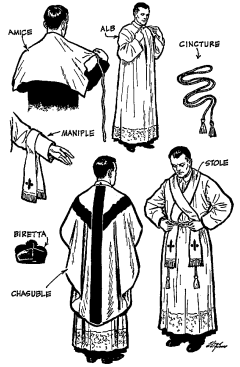
“Alba” means white in Latin. This is a long white linen garment symbolizing innocence and purity, covering the entire body.
Vesting Prayer: “Make me pure, O Lord, and cleanse my heart; that being made white in the Blood of the Lamb I may deserve an eternal reward.”
Amice
A hood or hood-like cloth. A rectangular piece of linen with an embroidered cross , wrapped around neck, shoulders and breast. It is representative of the garment of the cloth that the Roman soldiers placed over our Lord’s head as they blindfolded, mocked and struck Him. Formerly used as a head covering to protect clerics from the elements, it represents the helmet of salvation.
Vesting Prayer: “Place, O Lord, on my head the helmet of salvation, so that I may resist the assaults of the devil.”
Stole
The Stole was first adopted in the 4th century. It is a long thin vestment worn by bishops and priests around the neck and hanging down on both sides in front. It is worn across the chest and back by a deacon. In antiquity it was worn by judges, and reminds us of the priest’s apostolic authority and ability to forgive sins. It is worn across the chest.
Vesting Prayer: “Restore to me, O Lord, the state of immortality which I lost through the sin of my first parents, and, although unworthy to approach the Sacred Mysteries, may I still receive eternal joy.”
Maniple
In antiquity, maniples were often worn by Roman magistrates at the start of public events. It is a long cloth draped over the left forearm similar to a waiter’s napkin and pinned in place. It is a sign of repentance. Also called the “sudarium” or “sweat cloth” because it was originally used to wipe perspiration. It is shaped like a “mini” stole (see above). Today, it’s use is optional.
Vesting Prayer: “May I deserve, O Lord, to bear the maniple of weeping and sorrow in order that I may joyfully reap the reward of my labors.”
Cincture
The Cincture is a tied cord worn around the waist over the alb to hold it (and sometimes the stole) in place. It is made of braided cord and represents priestly chastity.
Vesting Prayer: “Gird me, O Lord, with the cincture of purity, and quench in my heart the fire of impure desires, that the virtue of restraint and chastity may abide in me.”
Chasuble
“Chasuble” is derived from the Latin “casula” or “little house” because it was used at times as a literal shelter in times of cold, wind and rain. This tells us how stiff and heavy it used to be. Traditionally, the vestment had a cross on the back to signify the yoke of service to our Lord. In times past it was very large, very heavy, and very ornamented, which is why altar boys used to help the priest when he raised his hands during Mass.
Vesting Prayer: “O Lord, who has said, ‘My yoke is sweet and my burden light,’ grant that I may so carry it as to deserve your grace.”
Dalmatic
This is a vestment of a deacon. It is shaped like a cross when the arms are outstretched. For freedom of movement sometimes it is open at the side from the sleeves down. Normally it is made of ornamented fabric. It was commonly worn as an outer robe in Dalmatia (modern Serbia, Croatia and Slovenia), hence the name.
Vesting Prayer: “O Lord, give to me, with the garment of salvation, the vestment of joy, and with the dalmatic of justice ever encompass me.
Biretta
The biretta is a stiff square cap with three or four upright projecting pieces extending from the center of the top to the edge. It sometimes has a pom pom in the middle. One possible origin is the academic cap of the high Middle Ages, which was soft and square. This is also the ancestor of the modern mortarboard used today at Graduations. It was originally worn by all non-monastic priests. It’s use today is optional.