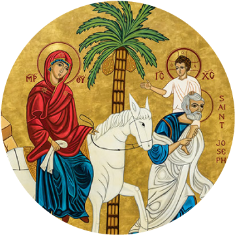

Clothed in Glory: Church Vestments
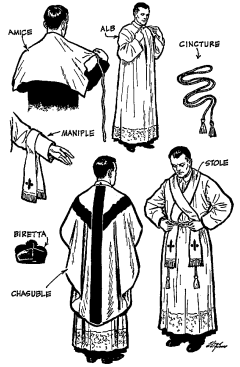 Clothed in Glory: Church Vestments
Their main function is to state to all that the man who wears them is called by God to teach, shepherd and sanctify the Christian people. In the Old Testament the priests were clothed in special clothes to signify the call of the Lord. The Lord speaks in Holy Scripture about the Apostles being “clothed with power from on high.” (Lk 24:39) Also, in Isaiah 61:10 we read, “For God has clothed me with the garments of salvation, He has covered me with the robe of righteousness.” Psalm 29:2 speaks of worshiping “the Lord in the splendor of his holiness.” By wearing these vestments, a priest is meant to “cover up” his own will and desires and stand before God’s people as one who is willing to do God’s will and desire. His authority comes from God who sends the grace of the Holy Spirit upon his priests. Church vestments have the purpose of setting aside everyday styles which change and can be distracting. The priest, unworthy though he be, is clothed by God with the grace of the priesthood for the building up of the Kingdom.
Catholics and Prayers for the Dead
“I Believe in the resurrection of the dead and the life of the world to come.”
In the month of November we especially remember our beloved who have fallen asleep in the Lord. While we should remember our deceased loved ones and friends every day in our prayers, November is the month of All Souls.
In our parish there is the “Book of Life” and all are invited to write the names of deceased family and friends in this book. During the month of November this Book of Life is placed under the altar and those inscribed in the book are remembered in all Masses during that month.
The Mass is the ultimate prayer offered for the deceased, for the forgiveness of their sins and for a place with God in Paradise. The Mass is a participation in the Lord’s death on Calvary and it is a sacrificial offering to God for the salvation of the deceased. It is a memorial of His life-giving resurrection as well.
Our Faith teaches us that we must reverently bury the body of the deceased as we await the final resurrection and the coming of Lord on the Last Day. The prayer of blessing a grave asks God to make “holy the graves of the just” as it becomes the resting place of one awaiting the renewal of all creation at the Second Coming of Christ.
The practice of cremation is allowed by the Church today. For centuries this was not the case. Christians, in imitation of their Lord, were buried. Burning of the body is a non Christian practice. Since the body was a temple of the Holy Spirit in life, the body is to be treated with respect. While cremation is allowed, it is not the preferred method of care of the body after death. If a Catholic chooses cremation the ashes are to be buried as the Lord was buried. Scattering the ashes is a pagan custom which shows disrespect for the one who has died and a lack of understanding of the Christian faith.
As Catholics we offer Masses for our loved ones. By sharing in the Holy Sacrifice the living and the dead benefit from the grace God gives through the Sacrament of the Lord’s own death and resurrection.
More than flowers, bequests or a donation, the Eucharistic Sacrifice is a powerful blessing for the dead as well as the living. This is why we offer Masses for those who have fallen asleep in Christ. Traditionally we do these on anniversaries of the death of loved ones but Masses for the dead can be offered at almost any time.
The early Christian teachers and Fathers of the Church taught of this ancient practice. Their words are still true today.
St. Cyril of Jerusalem (d. 386) taught that in the Eucharistic Liturgy both the living and dead are remembered, and how the Eucharistic Sacrifice of our Lord is of benefit to sinners, living and dead.
St. Ambrose (d. 397) preached, “We have loved them during life; let us not abandon them in death, until we have conducted them by our prayers into the house of the Lord.”
St. John Chrysostom (d. 407) said, “Let us help and commemorate them. If Job’s sons were purified by their father’s sacrifice, why would we doubt that our offerings for the dead bring them some consolation? Let us not hesitate to help those who have died and to offer our prayers for them.”
St. Gregory, pope of Rome, (d. 604) taught, “Let us not hesitate to help those who have died and to offer our prayers for them.”
We should not presume to know the inner heart and mind of those who have died. It is not within our power to know their complete relationship with God or assume that they do not need our prayers. To do so is to neglect the good we can do for our loved ones who have fallen asleep. In the Creed we say, “I believe in the communion of the saints…” Catholic Christians accept the faith of our ancestors which teaches that we are in living communion with our brothers and sisters who are in the glory of heaven or who are being purified after death.
To offer Mass for loved ones you can call the parish office (580.536.6351) to schedule a Mass year round. An offering of $10 is suggested but never required for a Mass (either for the intention of the living or the salvation of the deceased).
A Prayer for those who have died
Into Your hands, O Lord Jesus Christ, I commend the souls of Your servants, [insert names], and I ask that you may grant them rest in the place of Your rest, where there is neither sorrow, nor sickness, nor sighing, but life everlasting. I ask also that You may grant that the remainder of our present lives be godly and faithful, as we work out our own salvation with fear and trembling*; that we also may be counted worthy to enter Your unapproachable Light to dwell with those whom we love but see no longer. For You are the resurrection and the life, and the hope, and the repose of all Your servants O Lord, and to You we give glory: to the Father, and to the Son, and to the Holy Spirit, forever and forever. Amen.
* Philippians 2:12-13

Parish Lenten Project 2024
Brothers and Sisters,
Glory to Jesus Christ!
Due to Lent and the Passover of the Lord (Easter) coming so early this year there is a conflict between the Archdiocesan Annual Catholic Appeal (which supports the work of our Archdiocese) and our Parish Lenten Project (support for our local poor through the works of the St. Vincent de Paul Society).
Therefore, our Parish Lenten Project, support for the poor in Lawton, will take place between Easter and Pentecost (the end of March through May).
During this Easter Season we celebrate the mercy of Christ through His ministry after His resurrection.
It is a good time to share in these gifts of mercy given to us by doing as the Lord did by bringing Good News to the poor.
When the time comes I ask you to be generous in your response to help our St Vincent de Paul Society.
The good works they do in the name of our parish raise up those who struggle to seek help in basic needs.
May this Lent and the celebration of the Passover of the Lord, from death to life, be a time of great closeness to the Lord.
In Christ our God,
Fr. Phil
Icons in Holy Family Church - Part 1
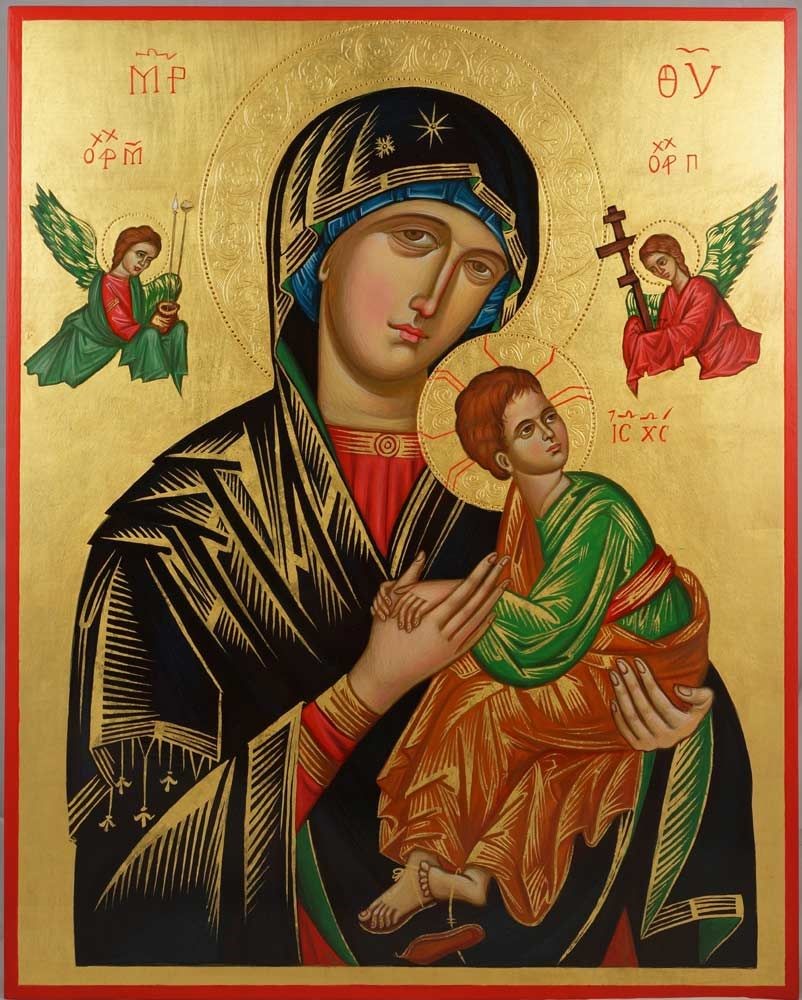
Our Lady of Perpetual Help, found in the little chapel
 The Falling Sandal
In the West this icon is called, "Our Lady of Perpetual Help." In the East it is called “Mother of God of the Passion”
This icon and all icons belong to an ancient form of liturgical art. Icons follow a certain pattern and style different from other forms of sacred art. Icons paint the Gospel in color and light.
The icon of Our Lady of Perpetual Help was painted in Crete. Carbon dating places the icon in a period around the second half of the 14th century.
This particular icon depicts the Virgin Mary holding the Lord, our God, who became a child. Christ, “…emptied Himself, taking the form of a servant, was born and came among us as a man (Philippians, 2:7). We are called by the Lord to become “partakers of the divine nature” and to truly share in the life of God the Holy Trinity (2 Peter, 1:4). In extreme humility Christ our God came among us as man so we might share in His divinity as He shares in our humanity.
According to an ancient tradition, this type of icon was inspired by a painting no longer in existence which is said to have been painted by St Luke the Evangelist. This style of icon is called “Hodegetria,” a Greek word which means ‘She who shows the Way’. Mary always points us to Christ (John 2:5).
What Happens at the Dedication of the Church?
Fasting and Abstinence Regulations During Lent 2024
Here is what the Church asks of us regarding fasting and abstinence during Lent:
- Ash Wednesday is on February 14, 2024
- Everyone 14 years of age or older is bound to abstain from meat on Ash Wednesday, all the Fridays of Lent and Good Friday.
- Everyone 18 or older, and under 59 years of age, is called to fast on Ash Wednesday and Good Friday.
- On Ash Wednesday and Good Friday, only one full meatless meal is allowed. Two other meatless meals, sufficient to maintain strength, may be taken according to each one’s needs, but together they should not equal another full meal.
- Eating between meals is not permitted.
- When health or ability to work could be affected, the law is not imposed.
- Nursing mothers and the sick are not required to fast or abstain.
- Catholics should not lightly excuse themselves from these prescribed minimal penitential practices.
- Fasting and abstaining from meat without prayer is useless. Prayer consecrates our fasting to the Lord.
Prayer for an End of the Corona Virus ~ 10/14/2020
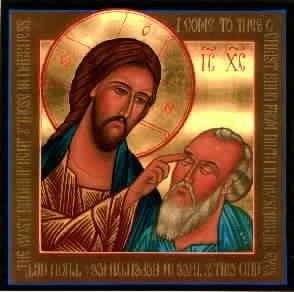 Prayer for an End of the Coronavirus
O God Almighty, Lord of heaven and
earth, and of all creation visible and
invisible, in Your indescribable
goodness, look down upon Your
people gathered in faith. Be our helper
and defender in this time of affliction.
You know our weakness. You hear
our cry in repentance and contrition of
heart. O Lord who loves mankind,
deliver us from the threat of the
coronavirus. Send Your Angel to
watch over us and protect us. Grant health
and recovery to those suffering from this virus. Guide the hands of physicians and researchers.
Healer of our ills, preserve those who are healthy, that they may continue to serve
You in peace and glorify Your most honorable and majestic Name, Father,
Son, and Holy Spirit, forever and ever . Amen.
Mother of God, Health of the Sick, pray for us.
40th Anniversary of Dedication - 30 October 2020
Happy Anniversary!
October 30, 2020
Forty years ago, on October 30, 1980, our parish church was dedicated for the honor and glory of God. Just as it is the custom to celebrate anniversaries of marriage, priesthood and religious profession, it is also the custom of the Church to celebrate the major anniversaries of the dedication of our parish churches.
Click the button to read about our celebration!
Prayer Before the Election
our eyes to see the hungry, naked, the homeless and stranger among us. Strengthen our wills to feed, clothe, and provide shelter to them. Enlighten our minds with your grace and strength to protect life from conception to natural death doing always what is pleasing to you. Grant that our choice may be faithful to the life affirming Gospel of your Son.
The Purpose of Mass Intentions - Part 1
Mass Intentions (Part 1)
Why do we offer Masses for the Living and the Dead?
“The offering of prayer at the Liturgy is more powerful than any prayer.”
-St John Maximovitch
Each Mass that is offered in the Catholic Church has an “intention.” The intentions are prayers offered for a person living or reposed.
Salvation is union with God. As we live in this world we see life in an imperfect way, but one day we shall see fully what God intended for us in the life of the world to come. Then we shall see God face to face.
Salvation is not just a one-time choice or event, it is a daily, conscious choice to unite ourselves with God.
We do not believe that there is one single point when we make a decision for Christ and we are “saved.” We do believe that salvation is an ongoing process throughout life.
Sometimes a protestant friend or person will ask, “Are you saved?” They believe that inviting Jesus into their hearts and admitting they are sinners in need of a Savior is all that is needed to be “saved.” Many believe, “Once saved, aways saved”, yet that is not found in the Bible. It is an invention of 18th century protestant teachers. The early Christians, our ancestors, wouldn’t even know what “getting saved” meant.
When we are asked the question, “Are you saved?” the answer is always,
“I have been saved, I am being saved, I will be saved.”
Salvation: union with God is a lifetime process. God, the Father, the Son and the Holy Spirit, are always working for our salvation. They are always calling us, loving us and willing us to accept life with them. It is about an ongoing relationship, not one choice made at a certain point in our lives.
Non Catholics may not accept this answer, but it is both Scriptural and part of what the Church founded by Jesus has always taught. Our protestant friends might quote some Bible verses, but most are taken out of context and all are a personal interpretation of their meaning. The Bible is the book of the Catholic Church, inspired by the Holy Spirit, compiled by the Catholic Church and interpreted by the Church, not each individual. That is why there are so many protestant groups all claiming to be “the Church.” They believe in private interpretation so one passage means one thing to one person and something else to another. We cannot and should not presume to know the mind of God.
Salvation is union with God. Those who are “saved” have cooperated with God in this life and sought to live in union with Him.
For this reason we pray for one another, “…that all might come to the truth and be saved.” (1 Timothy, 2:4)
The greatest prayer we have is the Mass, with an intention offered for a person, living or dead, or for a special need. The prayers of the Mass offered and the offering of the Body and Blood of Christ to the Father have spiritual benefits. These are “applied” to the needs of the person for whom the Mass is offered.
When a loved one dies (or as the Church prefers say, according to the Scriptures, “falls asleep in the Lord”) they can take nothing with them except the love and prayers of the those they have left behind.
Contrary to non Catholic belief, we Catholics don’t suppose we know the mind of God and what was deep in the heart of a loved one who has fallen asleep.
The teaching of the Church is that if someone was faithful to Christ and His Church, obeying the Commandments, sharing in the Sacraments and striving to become more like Christ, we can have a well-founded hope that they will go to God to be with Him for all eternity.
Catholics and Orthodox Christians do believe that there is an “intermediate” state of being, where the souls who died in friendship with God might “wait” before entering Paradise.
While they may have died in the friendship with God, they may not be ready to look upon Him face to face. We might say using a phrase from our time, “There are unresolved issues.” Catholics call this “intermediate” state “purgatory” where some souls who died in friendship with God are prepared to enter the fullness of Paradise. Our prayers, acts of charity and especially the offering of the Mass help our beloved dead to enter into the fullness of God’s life.
What is a Catholic Funeral - Part 1
A Catholic funeral is a funeral using the prayers and rituals of the Catholic Church.
The purposes of a Catholic funeral are:
1) to entrust the soul of the departed to God
2) to pray for the forgiveness of their sins
3) to pray for their entrance into the Kingdom
4) to pray for the living who love the one who has died and ask the Lord
Regarding the Coming Election
Many are asking when the Church is going to make statements or even "endorsements" of political candidates. She isn't. Some in the Church, only speaking for themselves, share their opinions regarding candidates but they do not speak for the Church whether they be clergy or laity.
The Church cannot take sides regarding candidates. However, she can and must take sides regarding issues. It is not and has never been the practice of the Church to endorse candidates.
Meet the Saint in our Narthex: St. José Luis Sánchez del Río
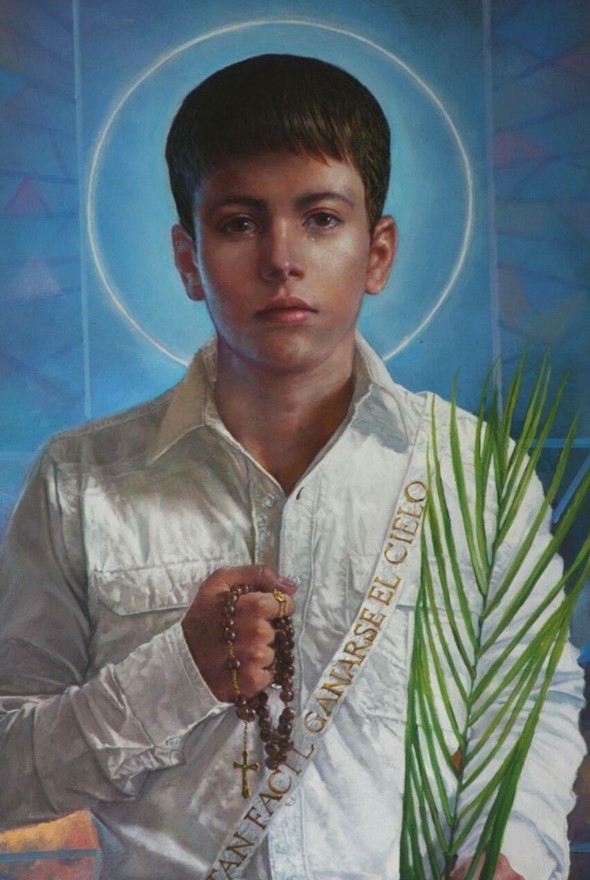
Meet the Saint in our Narthex:
St. José Luis Sánchez del Río
San Joselito (“Little Joseph” as he was called by family and friends) was born on March 28, 1913 in Sahuayo, Michoacán, Mexico as the third of four children in his family. José loved his faith and grew up with a strong devotion to Our Lady of Guadalupe.
José was 12-years-old when the Cristero ("Those who belong to Christ") War began in Mexico. During this time, the Mexican government wanted to extinguish the influence of the Catholic Church throughout the country. They started executing priests, seizing the Catholic Church's property, and closing religious schools and convents, in accordance with Socialist anti-clerical laws that were written into the Mexican Constitution.
People from many of the central and western states in Mexico rebelled against the government in defense of the Catholic Church. Joselito’s brothers joined the forces, but his mother would not allow him to participate. Prudencio Mendoza, the Cristero general, also refused José's enlistment because he was too young to join the rebellion.
But José desperately wanted to be a Cristero. He wanted the chance to stand up for his faith. He begged his mother to let him join, saying, "Mama, do not let me lose the opportunity to gain Heaven so easily so soon."
The general finally allowed José to become the flagbearer of the troop. José was nicknamed Tarcisius by the Cristeros, after the early Christian young saint martyred for protecting the Holy Eucharist.
His joy sweetened the sad moments of the Cristeros and everyone admired his gallantry and courage. At night he led the Holy Rosary and encouraged the troops to defend their faith.
On February 5, 1928, combat took place near Cotija. The general's horse fell dead of a bullet, Young Jose got down from his mount with agility and said: "My general, here is my horse, save yourself, even if they kill me. I don't need to do it and you do" and handed him his horse.
In combat he was taken prisoner and brought before the Socialist general who reprimanded him for fighting against the Government and, seeing his decision and courage, told him: "You are brave, boy. Come with us and you will do better than with those Cristeros." "Never, never! First dead! I do not want to unite with the enemies of Christ the King! I am His! Shoot me!"
The general had him locked up in the Cotija prison, in a dark and smelly dungeon. Josélito asked for ink and paper and wrote a letter to his mother in which he said:
“Cotija, February 6, 1928. My dear Mama: I was taken prisoner in combat on this day. I think I'm going to die, but it doesn't matter, Mama. This is God's will; we cannot resist it. Don't worry about my death... do the will of God, have courage, and send me a blessing together with my father's..."
On February 10, 1928, at about 6 o'clock in the afternoon, they took him out of the prison and took him to the barracks. At 11 o'clock in the evening the last hour came. They skinned his feet with a knife, took him out of the building and made him walk to the cemetery. The soldiers wanted to make him deny Christ by force of cruelty, but they did not succeed. God gave him strength to walk, shouting “Long live Christ the King and “Our Lady of Guadalupe
When he reached the cemetery, he was asked where he wanted to be buried. With great courage, he stood at the edge of an open grave, to spare the executioners the work of transporting his body.
The murderers then pounced on him and began stabbing him. At each stab he shouted again: "Long live Christ the King! Long live the Virgin of Guadalupe!" In the midst of the torment, the chief captain of the escort asked him, not out of compassion, but out of cruelty, what he would like his parents to hear as his last words. Jose replied: "We will see each other in heaven. Long live Christ the King! Long live the Virgin of Guadalupe!" As these exclamations came out of his mouth, the captain shot him in the head, and the boy fell into the grave, bathed in blood, and his soul went to heaven. It was February 10, 1928.
Without a coffin and without a shroud, he received the shovels of earth directly and his body was buried, until years later, his remains were buried in the crypt of the of Church of Reparation of the Sacred Heart of Jesus. They currently rest in the parish church of Santiago Apóstol, in Sahuayo, Michoacán.
He was canonized by Pope Francis on October 16, 2016.
He is the patron saint of our youth group at Holy Family parish, young Christians in general and persecuted Christians.
Viva Cristo Rey! Viva Virgen de Guadalupe! San Joselito, pray to God for us!
Catholic Care for the Seriously Sick or Dying
When we or a loved one becomes seriously ill
Our Catholic Faith teaches us that when anyone is seriously ill (in hospital, care
center or home) it is proper to call a priest.
The Anointing of the Sick can offer God’s power to comfort, possible physical
healing, and spiritual strength to bear the burden of being sick.
“Are there any who are sick among you?”
another, that you may be healed." (James 5:14-16a)
It is never good to wait until someone is unresponsive, since Confession and receiving Holy Communion are generally part of the Sacraments Christ gave us for the healing of our souls and bodies.
Anyone with a chronic serious medical condition or undergoing serious surgery may also request the Anointing of the Sick.
Calling a priest is not a sign that the person is going to die, it is a sign of the Lord’s loving care for us. Christ gave us the Sacraments to help us and they should be used for that purpose.
“Christ Jesus, stretch forth Your hand so full of healing and compassion, drive away all illness, fear and pain and raise Your servant from all sickness of soul and body…”
When someone is in danger of dying, a priest should be called.
“The Last Rites”
The Last Rites ideally are given to help the person on their journey from this world to the life of the world to come. Death can be a fearful thing. Thoughts of, “What is next?”, leaving loved ones, or fear of past sins can cause the dying person anxiety which is added to the difficult natural process of dying. But the dying one is not meant to be alone. Christ, through the Church, offers prayers and food for the journey. The priest offers confession (if possible), absolution from sin, he brings the food of immortality (the Body and Blood of the Lord) and prayers of comfort. With the dying loved one’s family the priest helps “pray” the person into the Kingdom of God.
“In death, life is changed, not ended, when our body lies in death we
gain an everlasting dwelling place in heaven.” (Preface I, Mass of Christian
When in doubt regarding your own health or that of a loved one, please call the parish office 580.536.6351. If someone is actively dying please call the parish emergency line, 580.531.2607 (this is for after office hours and for the needs of the dying). This emergency line is only answered and responded to for medical emergencies.
“Receive, O Lord, Your servant, as a sheep of Your own flock, a lamb of Your own choosing, into the heavenly pastures, in that place of rest, refreshment and peace, where sorrow, pain and tears have been banished…”
Do Not Forget to Pray!
Prayer is the way to renewal and spiritual life. Prayer is aliveness to God. Prayer is strength, refreshment, and joy. Through the grace of God and our disciplined efforts prayer lifts us up from our isolation to a conscious, loving communion with God in which everything is experienced in a new light. Prayer becomes a personal dialogue with God, a spiritual breathing of the soul, a foretaste of the joys of God's kingdom.

|

|